
Ring.
The bell echoes through the classroom.
Before the teacher has even finished saying, "Have a great day," backpacks unzip, hoodie pockets are searched, and hands instinctively reach for the little glowing treasures that have been waiting for the last 55 minutes.
Three minutes.
Three minutes to walk to the next class.
Three minutes to catch up on everything that happened while the phone was out of reach.
Four new Snapchats.
Five Instagram notifications.
A text from a friend.
A streak to save.
A comment to read.
Three minutes.
The hallways quickly fill with movement. Bodies shuffle. Shoulders brush together. Heads remain down. Eyes stay fixed on glowing screens.
No eye contact.
No conversation.
Just the endless race to answer notifications that suddenly feel urgent.
As students weave through the hallway, Mrs. Frank smiles and offers the same reminder she has given countless times before.
"Look up!"
Not because students are in trouble.
Not because they are in danger.
Simply because she wants them to remember that there is a big, bright, beautiful world beyond the treasures they carry in their pockets. A world filled with conversations, laughter, friendships, and moments that cannot be experienced through a screen.
Yet those little glowing screens hold an incredible amount of power. Not because students are making poor choices, but because they are designed to capture and keep our attention.
The likes.
The notifications.
The endless scrolling.
The fear of missing something.
The little bursts of dopamine that keep pulling them back.
The bell rings again.
Students settle into their seats.
The teacher begins today's lesson.
But one student's thoughts are somewhere else.
Did anyone respond to my Snap?
I wonder if my friends think I'm ignoring them.
Did anyone comment on my picture?
"Here," she answers during attendance.
Present in body.
Absent in mind.
Forty-five minutes later, her hand goes up.
"Can I use the restroom?"
"We only have ten minutes left," the teacher replies. "Can you wait?"
She quietly shakes her head.
"Go ahead."
Nature isn't calling.
The phone is.
Waiting for her are seven new notifications.
She unlocks the screen.
A few likes.
A couple of encouraging comments.
Then one catches her eye.
"Maybe try a different angle next time."
She stares at the words.
Her excitement disappears instantly.
Standing alone in the restroom mirror, she begins examining every detail she hadn't questioned just moments before.
The bell rings.
Reality returns.
She hurries back to class, gathers her belongings, and moves on to the next period, carrying far more than just her backpack.
This scene may sound like fiction, but, unfortunately, for many students, it is not far from reality.
Our students are growing up in a world unlike anything previous generations have experienced. They don't simply carry phones in their pockets; they carry an endless stream of opinions, comparisons, expectations, entertainment, friendships, conflicts, and pressures with them every waking moment.
While these devices offer incredible opportunities to connect, learn, and create, they also compete constantly for our attention. Even a single notification can interrupt concentration, learning, and meaningful interaction.
Before we think about our students, think about yourself.
How often do you check your phone?
Do you reach for it every time it vibrates?
Do you unlock it to check one notification and suddenly realize several minutes have passed?
Have you ever picked it up without even thinking?
Most adults would answer yes.
If we, with fully developed brains and years of life experience, struggle to resist the pull of notifications, imagine asking an adolescent brain to ignore that same temptation while learning algebra, writing an essay, discussing history, or conducting a science lab.
This isn't about willpower. It's about neuroscience.
Social media platforms and smartphone apps are intentionally designed to capture and keep our attention. Every notification, like, streak, comment, and alert provides a small release of dopamine, the brain's reward chemical. Over time, checking a phone begins to feel less like a choice and more like a reflex. In many ways, these patterns mirror addiction, making it difficult for students to fully disengage, even when they want to.
Research continues to show what parents and educators are seeing firsthand: excessive phone and social media use can contribute to increased anxiety, shortened attention spans, sleep disruption, and constant comparison. Perhaps more importantly, it can quietly steal something students desperately need: the opportunity to simply be present.
Phones are not inherently bad. They connect families, provide information instantly, and offer entertainment and creativity. But like many things in life, when something begins to control our attention, emotions, and relationships, it deserves thoughtful boundaries.
Recognizing these challenges, the Burke School Board voted Monday evening to adopt a new cell phone policy for the 2026–27 school year. Under the new policy, students in grades 6–12 will secure personal electronic devices in school-issued locking boxes during the instructional day.
The goal isn't punishment.
The goal is opportunity.
An opportunity for students to focus more deeply in class.
An opportunity to have conversations in the hallway instead of scrolling.
An opportunity to build friendships face-to-face.
An opportunity to laugh, collaborate, create, and simply experience school without constant digital interruption.
As educators, we believe school should be a place where students feel connected to the people around them, not isolated behind screens. It should be a place where mistakes, growth, friendships, and learning happen in real time, not filtered through social media.
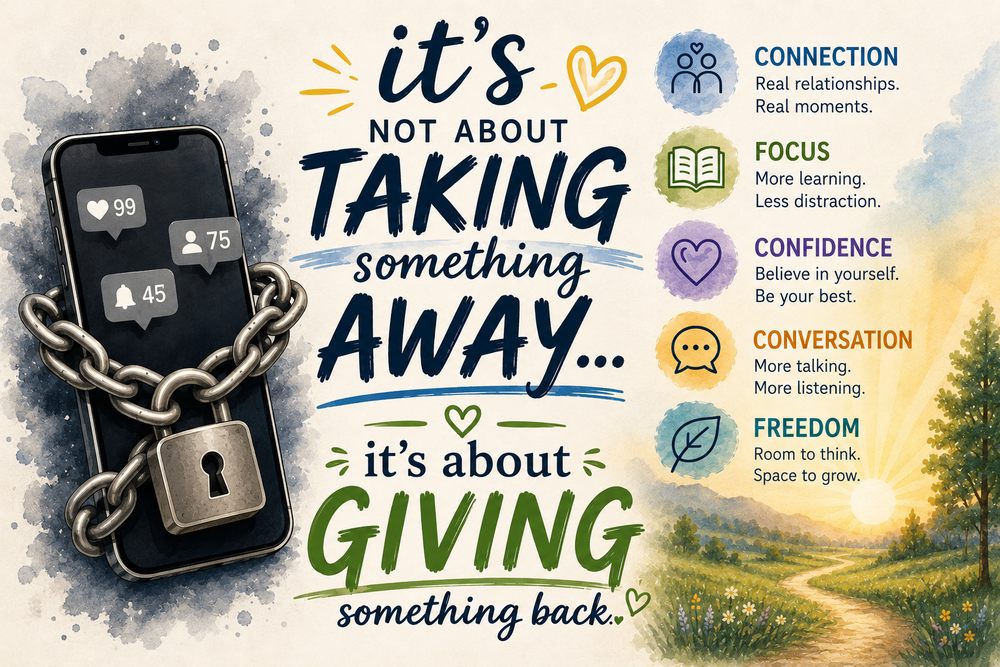
It's not about taking something away.
It's about giving something back.
Giving back focus.
Giving back conversation.
Giving back confidence.
Giving back connection.
Giving back the freedom to experience school without the constant pressure of a screen.
Giving back the simple joy of being fully present.
We know this change will require an adjustment. We know conversations about cell phones can bring strong opinions, questions, and even concerns.
To help everyone understand the new procedures, Burke School District will host an informational meeting on August 3 at 7:00 p.m. in the High School Gymnasium. Parents and guardians are encouraged to attend, learn about the policy, ask questions, and see how the locking boxes will be used throughout the school day.
We believe our students deserve every opportunity to succeed, not only academically, but socially and emotionally as well.
We are excited to see the positive impact this change will have on our classrooms, our culture, and, most importantly, our students.
Sometimes the greatest gift we can give them isn't another notification.
It's the freedom to look up.